The Churnet Valley Railway has a number of diesel locomotives onsite, and from time to time features guest locomotives appearing from other railways from around the UK. Below is a bit of history of the locomotives currently regarded as resident on the Churnet Valley Railway, with the proposed roster for the selected diesel turns on the Churnet Valley Railway in 2017.
- BR Class 20 no. D8057
- BR Class 25 no. 25322 "Tamworth Castle"
- BRCW Class 33 nos. 33021 "Captain Charles / 33102 "Sophie"
- YEC "Brightside"
- YEC Janus no. 2748 "6 Roger H Bennet"
- BR Class 47 no D1994 (47292)
25322 “Tamworth Castle” is the North Staffordshire Railways Companies “celebrity” diesel locomotive, having gained fame for being the final BR Class 25 to see mainline service with British Railways. D7672 was one of the final six 25s to be built, being delivered new to traffic on 25th February 1967 at London Midland Region’s Nottingham depot in BR’s allover cooperate Blue livery. From here she spent her entire career allocate to various LMR depots, from as far North as Carlisle Kingmoor down to Bescot, also seeing service at Preston, Liverpool, Springs Branch (Wigan) and Crewe. In April 1974 the locomotive was given its TOPS number of 25322.
In January 1984 ‘322 was withdrawn from traffic along with 25311 after their flask train caught fire. However in April ‘322 was selected for display at the upcoming Tamworth Rail Week, and so she was transferred to Tyseley Depot for repainting. She received a modified livery with full yellow cabs –nicknamed Ice Cream Van livery. Here she also gained the unofficial name of “Tamworth Castle” – railway myths suggesting the shed foreman at the time had a soft spot for the GWR Castle steam locomotives.
After her appearance at Tamworth Rail Week from 12-20th May 1984, ‘322 was reinstated into traffic due to a shortage of locomotives and allocated to Bescot once more. In 1985 BR implemented its new “Sectorisation Plan”, creating a specialized pool of locomotives to handle specific traffic flows. Carlisle Kingmoor Chemicals sub-sector received a dozen Class 25’s and the locomotives were given enhanced maintenance schedules and limited to 60mph to mitigate potential traction motor problems. 25322 became 25912, and joined the operational fleet in December 1985.
However the special traffic flows diminished rapidly with some expected services never materializing. This saw the full project cancelled in 1987 and ‘912 was withdrawn from service on 23rd March along with all remaining Class 25s across the UK.
Salvation was to come around once again however, as the locomotive was selected as a training tool entered departmental service as ADB968027 (though this number was never carried). Transferred to the Eastern Region’s depot at Leeds Holbeck on 15th April, the locomotive was repainted in BR two-tonne green as D7672 – despite never having carried this livery previously. This soon escalated into a full restoration by the training department, and spares were sourced from numerous withdrawn 25s at Bescot along with a set of miniature snowploughs from a Class 20. On 24th April 1989, an internal ceremony was held to mark the completion of the overhaul, and cast “Tamworth Castle” nameplates was fitted – making the loco the only class 25 to be named in BR service.
Elesewhere BR had started operating “celebrity” locos on service trains in an attempt to increase passenger numbers. D7672 received an invite for one such train, and so a test run was completed to Skipton and back on 19th February 1990. The following day saw TC doublehead the 0825 Leeds to Carlisle with 47422 and the 1242 return working. TC became a popular request for charter trains plus Depot Open Day visits, and a commemorative plaque was received at Doncaster during an Open Day visit on 20th May to commemorate the Training Departments achievement in overhauling the locomotive. All this subsequently saw the locomotive re-enter BR traffic on 15th September, though it remained in use primarily on railtours and making open day appearances.
BR’s finances came under scrutiny, and D7672 was seen as an unnecessary cost and so a final railtour from Leeds to Holyhead was arranged for 30th March 1991 before the locomotive was sold into private ownership. The successful bidder was the Churnet Valley Diesel Group, and following asbestos removal TC arrived at the group’s Cheddleton base in May 1991. However TC was far too big for the demonstration service operated at Cheddleton, and so TC went out on hire to various railways including the Kent & East Sussex Railway.
TC then returned to Cheddleton in 1995, as the Churnet Valley Railway prepared for the launch of its heritage services, with the first operation to Leekbrook commencing in August 1997. TC joined the operational fleet and was able to stretch her legs as the CVR extended South to Kinglsey & Froghall.
TC performed throughout the 90s along the CVR, but as the early 2000s dawned the repairs list started to mount. With the original members of the owning group having moved on elsewhere, ownership was transferred to the Churnet Valley Railway support charity (North Staffordshire Railway Company (1978) Ltd) and the original group dissolved.
In 2009 - D7672 was repainted into her Ice Cream blue livery for a EMRPS photo charter and regained her original TOPS number of 25322. Since then TC has remained in store within Cheddleton Yard whilst funds are raised for all necessary repairs. These are expected to start once the overhaul of 47524 has been completed, though offers of support are always welcomed.
The class 33 locomotives were built at the Birmingham Railway Carriage & Wagon Company works in Smethwick. 98 were built between 1960 and 1962. Fitted with a Sulzer 8 cylinder engine developing 1,550hp they were the first class of locomotive to be equipped with electric train heat from new and were also equipped with dual braking systems - vacuum and air.
The North Staffordshire Railway Company's class 33 33102 was originally numbered D6513 and in 1967 was selected as one of 19 locos of the class to be converted to 'push-pull' mode. This was to enable them to handle services over the non-electrified section of line between Bournemouth and Weymouth. She was carrying BR Blue livery by this time and then in 1973 was renumbered to 33102 under the British Rail TOPS scheme and became part of Class 33/1 - indicating a push-pull fitted loco.
She was withdrawn from mainline service in 1992, still carrying BR Blue livery, and by then had been unofficially named 'Sophie' by one of the depot staff at Eastleigh. The North Staffs Railway Diesel Group based at the Churnet Valley Railway were successful in buying her through a tendering process in 1993 and she was moved to the railway in October of that year. Following considerable restoration work including the fitting of replacement bogies she entered service on the railway in 1997.
By the end of 2009 'Sophie', now owned by the North Staffs Railway Co (1978) Ltd, was again in need of restoration and refurbishment. After a lengthy overhaul which included extensive body work, a rewire, new internal guttering and drains, replacement of cant rail grilles, complete strip down and overhaul of the compressor, new batteries and a complete repaint 33102 appeared in time for the CVR’s 2012 diesel weekend.
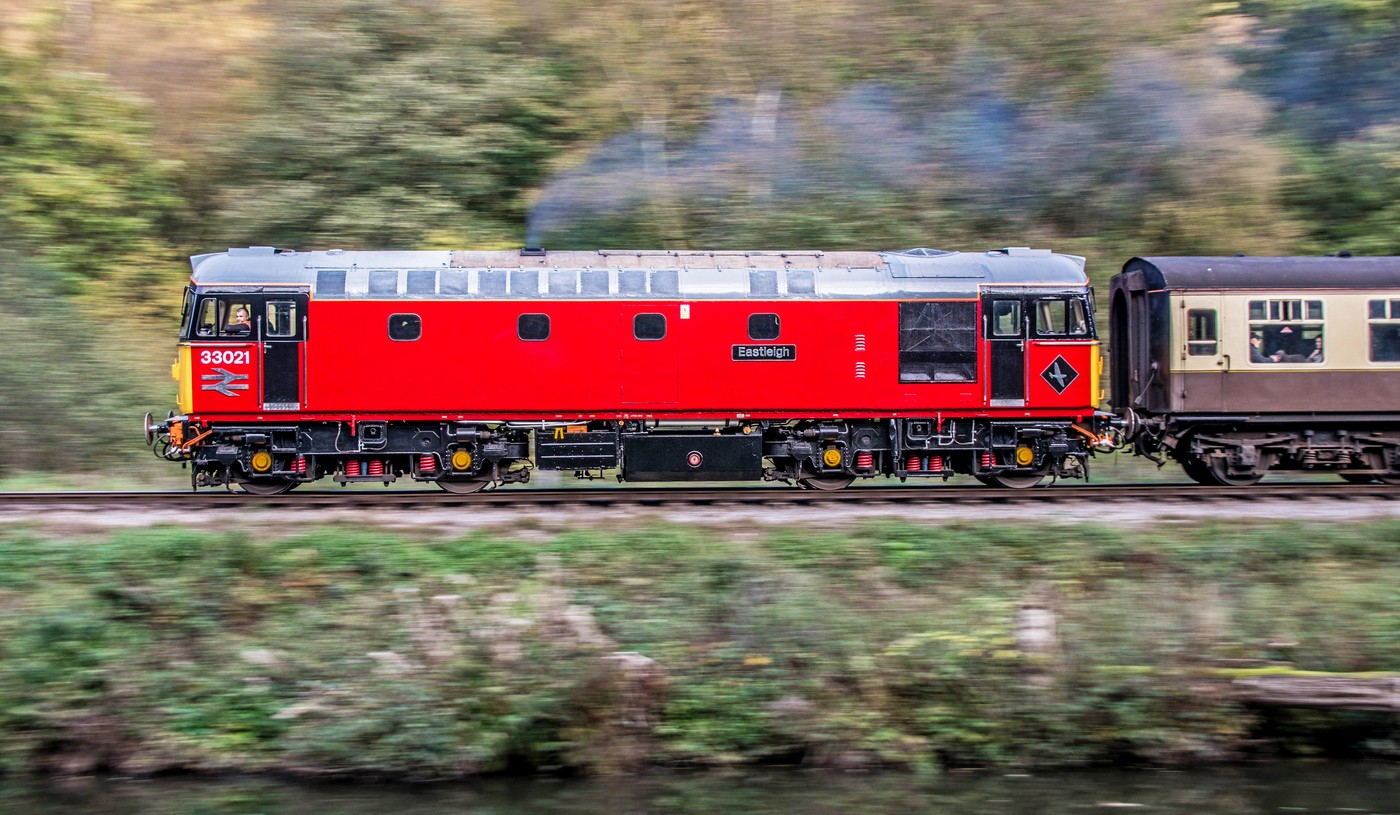
Class 33 no. (D6539) 33021 “Eastleigh” – (Operational)
33021 was originally numbered D6539 and in 1974 the loco - now carrying BR Blue livery -was renumbered to 33021 under the British Rail TOPS scheme and became part of Class 33/0 - indicating a non push-pull fitted loco. Withdrawn from mainline service in 1996 and then purchased privately and overhauled, carrying a Post Office Red type of livery, 33021 became one of the first privately owned diesel locomotives to be returned to use on the mainline. After a period out of use at Tyseley Depot the loco was again sold privately in late 2009, and following restoration and renovation, operated for the first time in more than 6 years in September 2010 at the Battlefield Line. Later that year the loco, now back in BR Blue livery, moved to the Churnet Valley Railway and in July 2011 was named 'Captain Charles' and painted in BR Blue Bandit livery.
Following cab repairs the locomotive was repainted into its unique red livery and renamed "Eastleigh".
No.6 "Roger H Bennett – Cheddleton MPD Shunter - (Operational)
"No.6" was built by the Yorkshire Engine Co. of Sheffield in 1959 (works number 2748) for the NCB, and was allocated to their Littleton Colliery in Staffordshire, where it was given their plant no 63/000/320. The loco was preserved and moved to the Buxton site of Peak Rail in July 1988 and returned to service. The loco moved to Darley Dale in May 1989 and was regularly used on the works trains towards Matlock in 1989 & 1990 - in 1993 it continued in use on the trains to Rowsley. The loco was sold in July 1993, and by March 1994 had returned to Industrial use at Cooper’s metals in Attercliffe, just a few miles from where it was built.
The loco was purchased in February 2003 and moved to Riversway in Preston, with the intention of the loco becoming the mainstay of the Ribble Rail loco fleet to operate the bitumen trains along the dock. Chosen due to her suitable ease of maintenance and power capability, the loco was named “Perseverance” and was to work alongside “Energy”, “Enterprise” and “Progress” on the docks hauling revenue earning trains. A full overhaul and repaint was carried out by the railway in preparation for the hard work in store for the loco, however there was a troublesome electrical issue which plagued the loco and so it was placed into storage in the Ribble museum building.
“No 6” was eventually purchased by the NSRC from Ribble Rail using proceeds left from the legacy of Roger Bennett, a volunteer on the CVR within the diesel department. The loco arrived on the Churnet Valley line in January 2008, and was named “"Roger H Bennett"” after the benefactor who helped pay for the acquisition. Like “No 6”, Roger himself spent time working at Peak Rail before coming to the Churnet Valley Railway.
Class 47 no. D1994 – Operational
For many years she was a mixed traffic locomotive and appeared all over the network but in later years her primary role was in the freight sector. Post privatisation she was operated by Freightliner and based at Crewe Basford Hall. That said, she occasionally worked passenger trains and visited heritage railways. Her last passenger train on the main line was "The Tayside Liner" charter train from Crewe to Perth and return on the 30th of August 2003. She carried on in service until the 31st of December 2003 when the engine was withdrawn as it was not scheduled for the fitting of Train Protection Warning System (TPWS).
She languished at Crewe Basford Hall yard for 42 months until June 2007. During this time, she was used as a "Christmas Tree" as a source of spare parts to keep sister locomotives in running order. The engine was put up for sale by Freightliner in Spring 2007 and acquired by a scrap yard but was immediately sold on to its current owners without ever leaving the yard. She did however leave by road transport on the 12th of June 2007 to go to the Great Central Railway Nottingham (GCRN) - a ten-mile-long section of the former Great Central main line from Ruddington to Loughborough.
In 2007, numerous visits were made to acquire missing parts, these included four vacuum exhausters, 1.5 triple pumps, turbo, lots of air and vacuum valves and associated pipework, electrical equipment including a full set of brushes / brushboxes throughout, windows and a part set of batteries. Revival took place at the end of August 2007 but in air braked mode only and she operated with a rake of ex Gatwick Express stock. 2008 saw the best two vacuum exhausters being installed along with all the missing brake valves and pipe work such that dual braking was now possible. In June of that year, she was treated to a full set of new batteries which lasted in service until June 2024 when these were replaced.
The start of 2009 saw an external repaint into BR Monastral Blue, grey roof, standard yellow cabs and large logo as carried until 2025. In July 2025 she ventured back on to the main line visiting the East Lancs Railway at Bury going via Stoke and Stockport.
2012 saw an invitation to attend the 50th anniversary of class 47s at the Mid Norfolk Railway at Dereham. She went in a five class 47 convoy to this then 12-mile-long line and an enjoyable few days were spent with other class 47 groups.
2014 saw her last foray on to the main line with visits to the Swanage Railway and Didcot Railway Centre that July. In her various mainline excursions, she ventured over MML, WCML, GWML and ECML metals - not bad for a scrap locomotive. 2014-19 saw regular operation at the GCRN with her last passenger train operating with a Santa Special in December 2019.
Then came Covid and she languished at one end of the yard for a long time resulting in general deterioration. Salvation came in contact from the Churnet Valley Railway enquiring if she could move to the CVR. This took place on the 22nd of June 2022, and work started to make her operational again. This has included extensive electrical work (including new batteries in June 2024), removal of the roof to replace much of the cooling system with new headers / manifolds / elements / pipework, anti-freezing the cooling system, extraction of air receivers for examination, replacing no 1 compressor motor, extensive repairs to exhaust silencer and associated roof well plus repairs to roof structure. A full repaint to two tone green livery with small yellow ends and red buffer beams to complete the works. A finishing touch will be naming the locomotive as she has never had a name. The nameplates have been acquired and refurbished and await fitting.
As part of the works various test trains have been undertaken both light engine and with stock. This has resulted in appearances at Froghall, Ipstones, Stoke branch and the new Leek Station. The engine was launched into traffic in June 2025 with a successful summer and winter period. Maintenance work will continue, with volunteers working on the locomotive weekly. If you are interested in getting involved, then please contact us via email to [email protected] or the website form.